French press coffee is full-bodied, forgiving and easy to scale for several people. A scale and a consistent grind make it much more predictable. Start with 60 g of coffee per litre of water, steep for four minutes and change the grind before changing everything else.
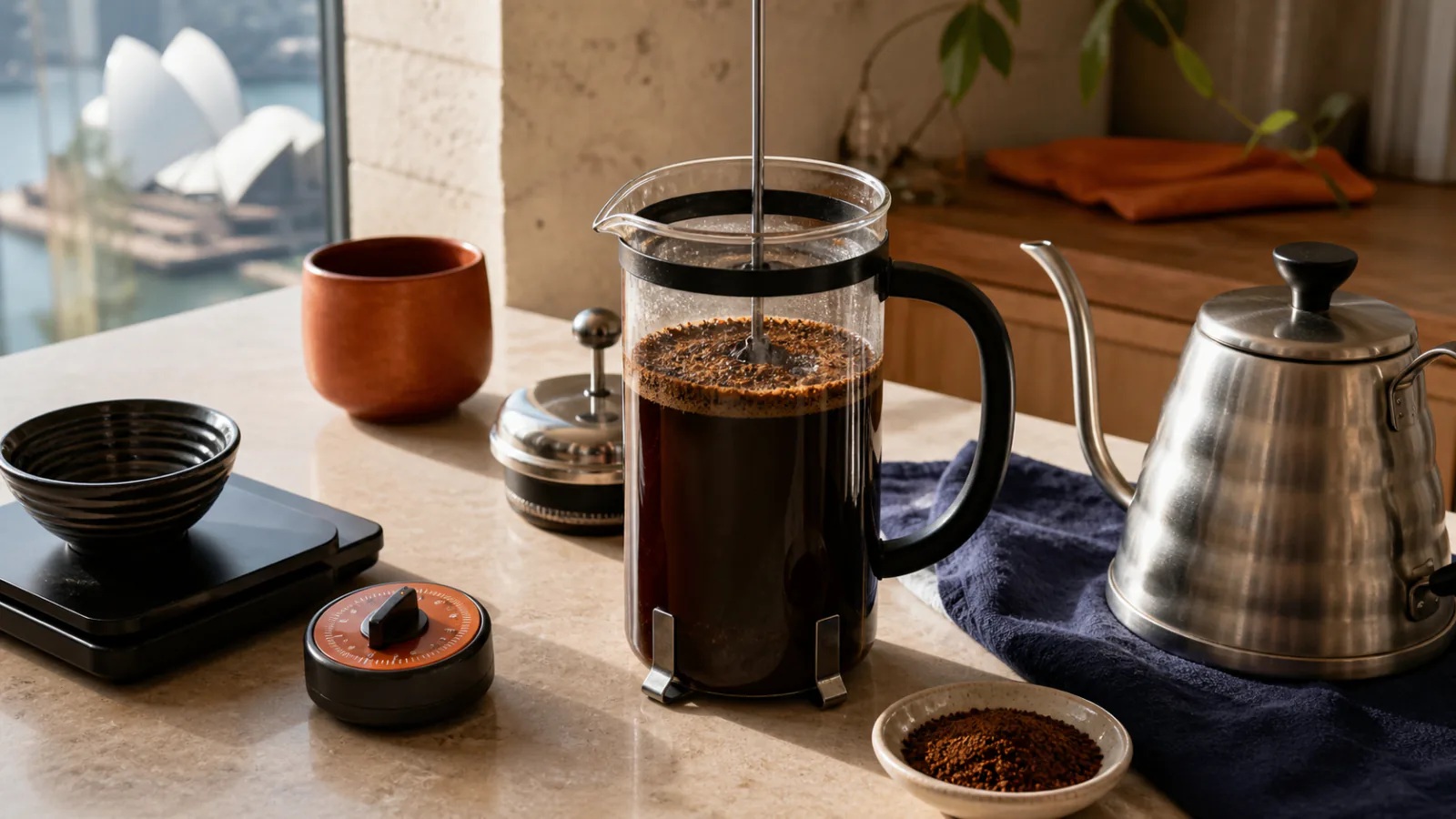
Use 30 g of medium-coarse coffee and 500 g of water at about 93 to 96°C. Add all the water, make sure every ground is wet, cover without pressing and steep for four minutes. Break the crust with a gentle stir, skim loose foam if you prefer a cleaner cup, then press slowly and pour all the coffee into cups or a separate server.
Quick French press recipe
30 g coffee + 500 g water + 4 minutes- Preheat the French press with hot water, then empty it.
- Add 30 g of medium-coarse ground coffee.
- Start the timer and pour 500 g of hot water evenly over the grounds.
- Stir gently so no dry pockets remain, then place the lid on top with the plunger raised.
- At four minutes, break the crust with a gentle stir and skim floating foam if desired.
- Press slowly and steadily, then decant the full brew immediately.
This everyday method is close to the parameters in the Specialty Coffee Association's French press brewing best practice, which uses 36 g of coffee, 660 g of water at 93.5°C and a four-minute total brew time. The small ratio difference is a matter of recipe preference, not a conflict.
Equipment that makes French press easier
- French press: Check its usable capacity rather than the number of cups printed on the box. Coffee equipment often counts a cup as smaller than a household mug.
- Burr grinder: A consistent medium-coarse grind helps avoid both powdery sediment and large under-extracted pieces.
- Digital scale: Water measured in grams is easy to repeat. For practical home brewing, 1 g of water is close enough to 1 ml.
- Kettle: Temperature control is useful, but not essential. If your kettle has no setting, let freshly boiled water settle briefly before pouring.
- Timer: A phone timer is enough. Start it as the first water reaches the grounds.
Fill the empty press with water to a safe level below the spout, then weigh that water. This tells you the practical maximum. Leave enough room for the ground coffee, crust and plunger.
Choose a French press coffee-to-water ratio
A 1:16 ratio means one part coffee to 16 parts water by weight. It is strong enough to hold the texture people expect from a French press without becoming needlessly heavy.
| Water | Coffee at 1:16 | Approximate serve |
|---|---|---|
| 250 g | 15 to 16 g | One small mug |
| 500 g | 30 to 31 g | Two small mugs |
| 750 g | 46 to 47 g | Three small mugs |
| 1,000 g | 62 to 63 g | Four small mugs |
Round to a measurement that is easy to remember. If you like a lighter cup, try 1:17. If you want more intensity, try 1:15. Keep the brew time and grind steady while comparing ratios.
Brew each step consistently
1. Grind medium-coarse
A good starting texture is coarser than pour-over and much coarser than espresso, with particles that look fairly even. Descriptions such as sea salt are only visual clues. Grinder designs differ, so use taste and resistance when pressing to refine the setting.
2. Use hot, suitable water
Start around 93 to 96°C. Water well below this range can leave the cup flat or sharp, while continuously boiling water can exaggerate harsh flavours in some darker roasts. Filtered water often helps when tap water has a strong chlorine smell or extreme mineral character.
3. Wet every ground
Pour steadily across the coffee and stir just enough to break dry pockets. Aggressive stirring is unnecessary and can push more fine particles through the metal filter.
4. Steep for four minutes
Put the lid in place to retain heat, but leave the plunger above the liquid. Start with four minutes. Extend the time only after tasting and checking the grind.
5. Press slowly and decant
Lower the plunger using gentle, steady pressure. If it is extremely difficult to press, the grind may be too fine. Do not force the plunger, because hot coffee can spill. Pour the entire brew into cups or a server so it does not continue extracting around the grounds.
Troubleshoot French press coffee by taste
| Problem | Likely direction | Try this first |
|---|---|---|
| Sour, thin or grassy | Not enough extraction | Grind a little finer |
| Bitter, rough or drying | Too much extraction or too many fines | Grind a little coarser |
| Weak but otherwise pleasant | Ratio is too dilute | Use more coffee, such as 1:15 |
| Too strong but not bitter | Ratio is too concentrated | Use more water, such as 1:17 |
| Muddy with heavy sediment | Grind has too many fine particles | Use a more consistent burr grinder and press slowly |
| Coffee cools too quickly | Brewer and cups absorbed heat | Preheat both before brewing |
Change one thing for the next brew and write it down. If you simultaneously change grind, ratio, water temperature and steep time, you will not know which adjustment helped.
Serve immediately and clean the press
French press coffee keeps extracting while it sits on the grounds. Decant it immediately, even if you are not ready for a second cup. A warmed insulated server can hold the extra coffee without continuing the brew.
Once the press is cool, lift out as many grounds as possible for compost or general waste rather than rinsing a thick bed into the sink. Separate the plunger components as the manufacturer allows, wash away trapped oils and rinse thoroughly. Old coffee oil can make a clean brew taste stale.
Medium and medium-dark coffees usually give this method a rounded body. If you prefer brighter black coffee, a medium single origin can work well. The coffee storage guide explains how to keep the rest of the bag protected between brews.
French press questions
How long should French press coffee brew?
Four minutes is a reliable starting time. Grind size, roast and temperature can change the ideal result, so taste before automatically adding more time.
Should I stir a French press?
A gentle stir after pouring helps wet dry grounds. You can also break the crust gently at the end. Avoid vigorous or repeated stirring, which can increase agitation and sediment.
Why is there sediment in my cup?
The metal mesh allows some fine particles and coffee oils through, so a little sediment is normal. A consistent burr grinder, a coarse-enough setting, slow pressing and leaving the final sip behind can reduce it.
Can I make one cup in a large French press?
Yes, if the plunger reaches the brewed coffee and the ratio remains correct. Very shallow brews can lose heat faster, so preheating becomes more important.