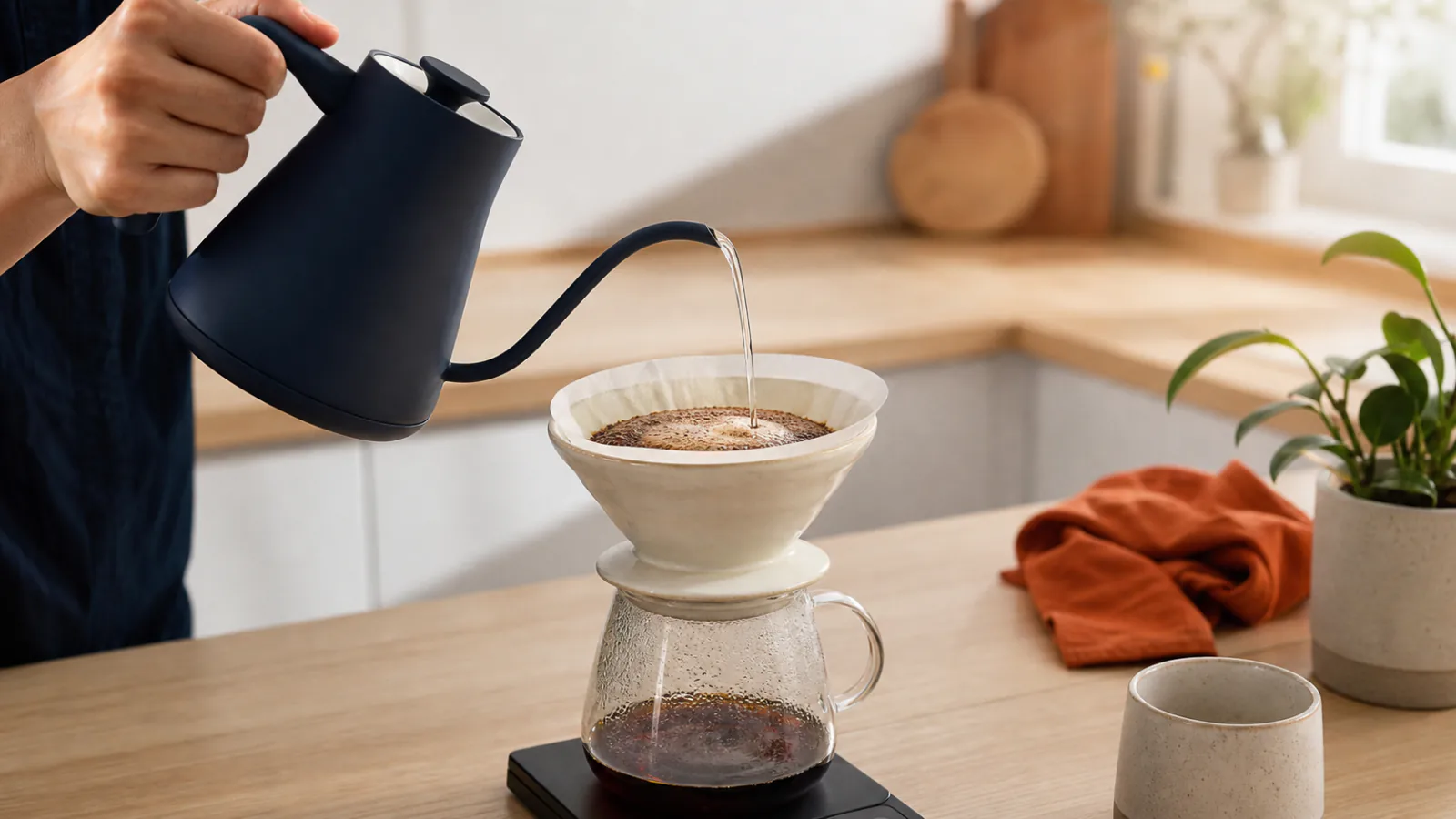
Pour-over coffee rewards a steady routine more than elaborate pouring patterns. Use a scale, keep the coffee-to-water ratio consistent and let the drawdown tell you when the grind needs to change. This 20 g recipe is designed for a medium cone dripper and produces one generous cup.
Use 20 g of medium-fine coffee and 320 g of water at about 90 to 96°C. Rinse the paper, add the coffee, then bloom with 60 g of water for 40 seconds. Pour steadily to 200 g, pause briefly, then continue to 320 g. Aim for a total brew time of roughly three to four minutes and adjust the grind by taste.
Quick pour-over coffee recipe
20 g coffee + 320 g water = a 1:16 brew ratio- Heat more water than the recipe needs so there is enough to rinse the filter.
- Place the paper filter in the dripper and rinse it thoroughly with hot water.
- Discard the rinse water, add 20 g of medium-fine coffee and gently level the bed.
- Start the timer and pour 60 g of water, making sure all the coffee becomes wet.
- At 40 seconds, pour in a controlled spiral until the scale reads 200 g.
- After the water level drops slightly, pour to a final weight of 320 g.
- Let the dripper finish draining, remove it and swirl the server before drinking.
This approach follows the core guidance in Hario's official 1:16 pour-over recipe: a bloom using two to three times the coffee weight, a 30 to 45 second bloom and a total brew time of about three to four minutes. Exact pouring stages vary between drippers, so treat the scale and taste as more important than copying a pattern perfectly.
What you need for pour-over coffee
- Cone dripper and matching paper: Use the filter shape and size designed for the brewer so it sits without folding into the coffee bed.
- Burr grinder: An even medium-fine grind makes the flow more predictable and reduces the mix of sour large particles and bitter fine particles.
- Digital scale: Choose one that reads to at least 1 g and can support the server, dripper and water safely.
- Gooseneck kettle: The narrow spout makes flow easier to control. A regular kettle can work if you pour slowly and avoid flooding the brewer.
- Timer: Use it to compare brews, not as the only definition of success.
- Server or sturdy mug: Confirm that the dripper sits securely before adding hot water.
A generous hot-water rinse removes loose paper flavour, warms the dripper and preheats the server. Remember to discard the rinse water before adding coffee.
Scale the coffee-to-water ratio
At 1:16, multiply the coffee dose by 16 to find the water weight. This keeps the strength similar when you make a larger or smaller brew.
| Coffee | Water at 1:16 | Useful for |
|---|---|---|
| 15 g | 240 g | One smaller cup |
| 20 g | 320 g | One generous cup |
| 25 g | 400 g | Two small cups |
| 30 g | 480 g | Two regular cups |
A larger brew usually needs more than a proportional dose change. The deeper coffee bed may drain more slowly, so you may need to grind slightly coarser. Make small changes and keep the final ratio constant while comparing.
Bloom the coffee evenly
Freshly roasted coffee releases carbon dioxide when hot water arrives. During the bloom, the coffee bed swells and bubbles while gas escapes. If you begin the main pour immediately, trapped gas can make it harder for water to wet the grounds evenly.
Use about three times the coffee weight for the bloom. With 20 g of coffee, pour 60 g of water. Start at the centre, move outward and stop before pouring directly onto the paper wall. A gentle swirl can help wet dry patches. Wait until about 40 seconds before the next pour.
Older coffee may show fewer bubbles, and darker coffee can produce a more dramatic bloom. Bubble size is not a quality score. The aim is simply to saturate the bed before the main extraction.
Use a steady, repeatable pouring technique
Keep the stream controlled
Pour from a comfortable height with a narrow stream that does not splash. Move in small spirals across the coffee bed. Spending most of the pour at the very edge can send water down the paper with less contact through the coffee.
Manage the water level
After the bloom, pour to 200 g, let the level fall a little and finish at 320 g. The coffee bed should stay submerged during the main pour without the dripper filling dangerously close to the rim.
Let the brew drain
When the kettle pour is complete, a gentle final swirl can flatten high grounds from the sides. Allow the water to pass through without shaking or repeatedly stirring the dripper. Remove it when the main stream becomes intermittent drips.
Use time as a clue
A three-to-four-minute brew is a useful target for this recipe, but paper, dripper geometry, grinder and coffee all affect flow. A delicious brew at 2:50 does not need to be slowed merely to reach a target. Likewise, a bitter brew at 3:30 may still need a coarser grind.
Troubleshoot your pour-over by taste
| Problem | What it suggests | Try this first |
|---|---|---|
| Fast drawdown, sour or thin cup | Water passed through too easily | Grind finer |
| Slow drawdown, bitter or drying cup | Flow was restricted or extraction was too high | Grind coarser |
| Sour cup with a normal brew time | Water may be too cool or the grind uneven | Use hotter water and check grinder consistency |
| Flat, weak cup without sourness | Ratio may be too dilute | Try 1:15 while keeping technique steady |
| Strong cup without bitterness | Ratio may be too concentrated | Try 1:17 |
| Brew stalls after a lot of agitation | Fine particles may be clogging the paper | Stir and swirl less, or grind coarser |
Lighter roasts often respond well to hotter water and a finer grind, while darker roasts may taste smoother with slightly cooler water and a coarser setting. Start in the recommended range, then let the cup decide.
Pour-over highlights clarity and origin character, so a rotating single origin is a natural choice. If you alternate between methods, the French press guide shows how to use the same 1:16 ratio for a fuller-bodied cup.
Pour-over coffee questions
What grind size should I use for pour-over?
Start medium-fine, finer than French press and much coarser than espresso. Because grinder scales differ, use drawdown and taste to find the setting rather than relying on a universal number.
Do I need a gooseneck kettle?
No, but it makes stream position and flow easier to repeat. With a standard kettle, pour gently in smaller stages and keep the water level safely below the rim.
Why does my pour-over take too long?
The grind may be too fine, the grinder may create many fine particles, or heavy stirring may have clogged the filter. First try a slightly coarser grind and less agitation.
Can I make pour-over without a scale?
You can, but volume measures make it harder to repeat the ratio because whole and ground coffee occupy space differently. An inexpensive digital scale usually improves consistency more than a complex pouring technique.