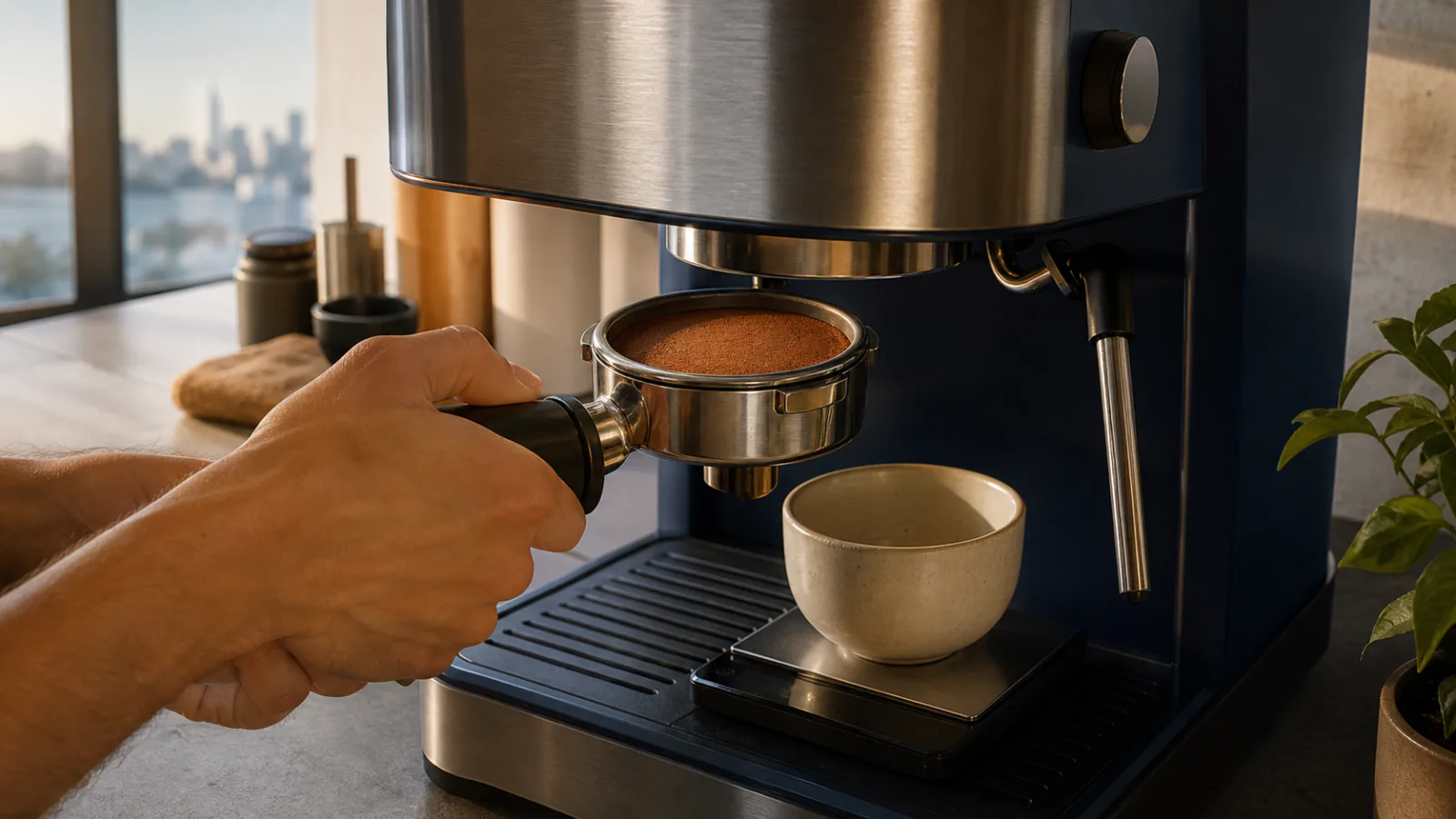
A Breville-style home espresso machine can make excellent coffee, but the buttons and pressure gauge cannot correct an unsuitable dose or grind. The fastest path to a better shot is a simple routine: warm the equipment, weigh the coffee, weigh the espresso, taste it and adjust only one variable at a time.
Start with the double single-wall basket, 18 g of freshly ground coffee and a clean, level tamp. Aim for about 36 g of espresso in the cup in roughly 25 to 35 seconds, including any pre-infusion your machine performs. If the shot runs fast and tastes sharp, grind finer. If it drips slowly and tastes bitter or dry, grind coarser.
A practical starter espresso recipe
18 g coffee in → 36 g espresso out → about 25 to 35 secondsThis 1:2 brew ratio is a dependable starting point for a double espresso. It is not a pass-or-fail rule. Basket capacity, roast style and personal taste can all move the ideal recipe.
For example, the official Breville Barista Express instruction manual lists 16 to 19 g for its two-cup filter basket. An 18 g starting dose sits near the middle of that range. If you use another model, follow its manual when the recommended basket dose differs.
Automatic shot buttons are convenient, but their programmed volume may not give the same espresso weight with every coffee. Put a small scale under the cup and stop the shot at the target yield while dialling in.
Set up the machine before adjusting coffee
A cold group head, cold portafilter or half-filled water tank adds noise to the process. Complete this short setup before changing the grinder:
- Fill the tank with fresh water. Fit the water filter if your model uses one and replace it on the schedule in the manual.
- Let the machine warm fully. Keep the portafilter locked into the group head so the metal warms too.
- Warm the cup. Hot water from the machine is enough. Empty and dry the cup before placing it on the scale.
- Purge the group head. Run a brief water-only shot, then wipe the shower screen if grounds are visible.
- Dry the basket. Water beneath fresh grounds can create uneven flow before brewing begins.
Warm-up time varies between machines. A ready light means the heating system has reached its operating state, but larger metal parts can need longer to become evenly warm. Consistency matters more than chasing a precise number of minutes.
Choose the right filter basket
Many Breville machines include both single-wall and dual-wall baskets. They are designed for different situations:
| Basket | Best suited to | What controls the flow |
|---|---|---|
| Single-wall | Fresh beans ground with an espresso-capable burr grinder | Grind size, dose and puck preparation |
| Dual-wall | Pre-ground coffee or a grinder with limited fine adjustment | The basket adds pressure and makes flow more forgiving |
Use the double basket while learning. It is generally easier to distribute and dial in than a single basket. Do not assume that a dual-wall basket is lower quality. It can be the practical choice when you do not have a suitable grinder.
Set the dose, grind and tamp
Weigh 18 g of beans, grind them into the dry basket and check that the mound can be distributed without spilling. If your model has a built-in grinder, its numbered setting is only a reference for that machine. Different beans may need a different number.
- Distribute the grounds. Settle them evenly across the basket before tamping. Break up obvious clumps with a suitable distribution tool if needed.
- Tamp level. Press until the coffee bed is firm and even. Once compacted, extra force does little to slow the shot.
- Clear the rim. Brush loose grounds away so the basket seals cleanly against the group head.
- Lock in and brew promptly. Leaving the portafilter in a hot group head can warm the dry coffee before extraction.
If 18 g leaves a deep impression from the shower screen or makes the portafilter difficult to lock in, reduce the dose to suit the basket. If the tamped puck sits unusually low, confirm that you selected the intended double basket.
Extract, taste and make one adjustment
Place the cup and scale beneath the portafilter, tare the scale, start the shot and stop it near 36 g. Record the dose, yield and total time. Then taste once the espresso is cool enough to judge safely.
| What happens | Likely cause | First adjustment |
|---|---|---|
| Fast flow, thin body, sharp or sour taste | Extraction is too low | Grind finer |
| Very slow flow, harsh bitterness or dry finish | Extraction is too high or flow is restricted | Grind coarser |
| Uneven, spurting flow and mixed sharp-bitter taste | Water found weak paths through the puck | Improve distribution and keep the tamp level |
| Balanced shot but too intense | The recipe is too concentrated for your taste | Increase the yield slightly |
| Balanced shot but too light | The recipe is too dilute | Reduce the yield slightly |
The pressure gauge is a diagnostic clue, not the goal. A shot can sit within a labelled espresso range and still taste poor. Use the gauge alongside flow, weight and flavour rather than trying to force the needle to one exact position.
If you are choosing a first bag, the guide to coffee beans for home espresso machines explains how roast profile and drink style affect an espresso recipe.
Steam milk and clean straight away
For milk coffee, begin with cold milk and a cold jug. Purge the steam wand briefly, place the tip just below the surface and introduce air at the start. Then lower the tip slightly to create a rolling movement that folds larger bubbles into fine foam. Stop before the jug becomes too hot to hold comfortably.
After every milk drink, wipe the wand with a damp cloth and purge it again. Knock out the puck, rinse the basket and run a short water flush through the group head. Empty the drip tray before it overfills.
Cleaning tablets, backflushing and descaling are different jobs. Follow the alerts and instructions for your exact model, especially because not every basket or machine uses the same cleaning cycle. Do not put cleaning product through the machine more often than its manual recommends.
Breville coffee machine questions
What grind setting should I use on a Breville machine?
There is no universal number. Start in the espresso range suggested by your model, then adjust by shot flow and taste. Even two machines of the same model can need different settings, and each new coffee may require a small change.
Why is my espresso puck wet?
A wet puck can come from basket headspace, dose, coffee age or the machine design. It does not automatically mean the espresso was poorly extracted. Judge the shot by its taste and repeatability first.
Should I use the razor dose tool?
If your model includes a dose-trimming tool, it can help identify an overfilled basket. Weighing the dose is still useful because it makes the recipe repeatable from one shot to the next.
Can I use pre-ground coffee?
Yes. Use the dual-wall basket if your manual recommends it for pre-ground coffee. Fresh grinding gives you more control, but the dual-wall basket is designed to make a fixed grind more workable.
Breville is a trademark of its respective owner. This independent guide is not endorsed by Breville, and controls vary by model.